
6 May 2019
In physics, a force is said to do work if, when acting, there is a displacement of the point of application in the direction of the force.
Work = Fd, where F = force and d = displacement
Question : If an object is pushed a distance of 4 m with a force of 2.5 N, calculate thee work done.
Work = Fd
Work = (2.5 N)(4 m)
Work = 10 Joules
The unit for work is joules
Work can only be done if there is a displacement. As discussed in class, weight lifters are not actually doing any work, because no matter how many times they pick up the weights and move them, and practice, eventually, they are going to put them back in the standard position, which means no displacement, and hence, no work was done.
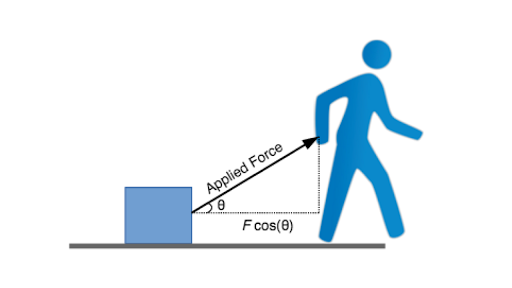
The two types of energy briefly discussed today were kinetic energy and gravitational potential energy. Kinetic energy is the energy an object has because of it’s motion. In order to accelerate an object, a force must be applied. This requires us to do work. Once a force has been applied, work has been done, and energy has been transferred to the object, the object will travel with a new constant speed, which is known as it’s kinetic energy.
We also briefly talked about LOL diagrams. These show the energy before the work is done, what happens when the work is being done, and the energy after (what kind of energy is there now? Was there any energy transfer?)

After Unit Reflection: In this post, I demonstrated an understanding of work. I gave the definition of work, the formula, what the letters in the formula stand for, doing an example calculation, and gave an example of how and why body builders actually do not do any work. These show a thorough understanding of the concept of work.
 Energy E Blog