
8 May 2019
3 Things learnt:
- The amount of dissipated energy equals the gravitational potential energy – kinetic energy.
With no friction, Eg1 = Ek2
2) LOL diagrams show the energy at the beginning, the circle shows what happens, the end shows the change in energy (if any)
The middle part shows a system (in class, we did the Earth/Train System) In physics, system is the name given to a collection of objects that are chosen to model with equations. If we are to describe the motion of an object using conservation of energy, then the system should include the object of interest and all other objects that it interacts with.
The example discussed in class was that of a roller coaster. When the train of the coaster was at point A, it has only gravitational potential energy. When it started moving, there were energy transformations, and by the time it reached the end of the first hill, that potential energy had been converted into kinetic energy.
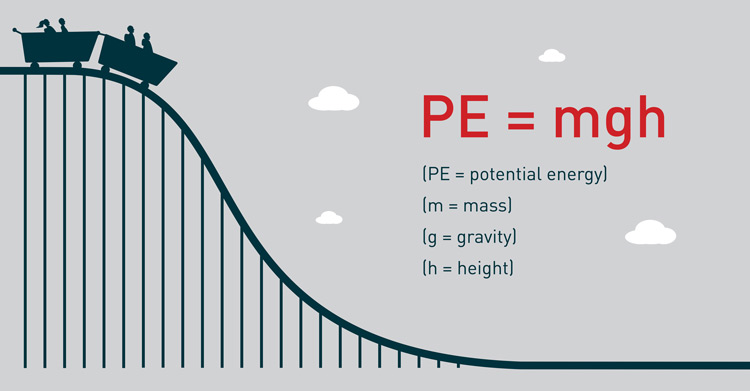
3) Gravitational potential energy is relative to a reference point.
Environmental Impact Of A Roller Coaster: A roller coaster has massive environmental impacts. It causes a large amount of pollution due to the large amounts of energy needed to keep it running. The large amount of space that is used to build a roller coaster also destroys some habitats and ecosystems.
Questions:
How much does friction affect the energy transformation?
How would we know, without calculation, an estimate if there is more kinetic energy left at the end or more disscapitated energy?
After Unit Reflection: This post shows an understanding of energy transformations, by explaining LOL diagrams and using the example of a roller coaster. I explained that by the time a roller coaster goes from the top of a hill to the bottom of it, the potential energy has been converted into potential energy. This also explains the Law Of Conservation Of Energy.
After Unit Reflection: In this post, I also assessed the environmental impacts of a roller coaster, which is a technology using energy transformations. I talked about how the energy used causes pollution, and the space used may destroy habitats and ecosystems.
 Energy E Blog